
Capture
Collect daily reports, tasks, attendance, integrations and manual evidence as performance signals.
Operentra HRM connects continuous merit evidence, daily reports, recurring tasks, appraisal cycles, weighted scores, badges and human-approved increment recommendations into one review system.
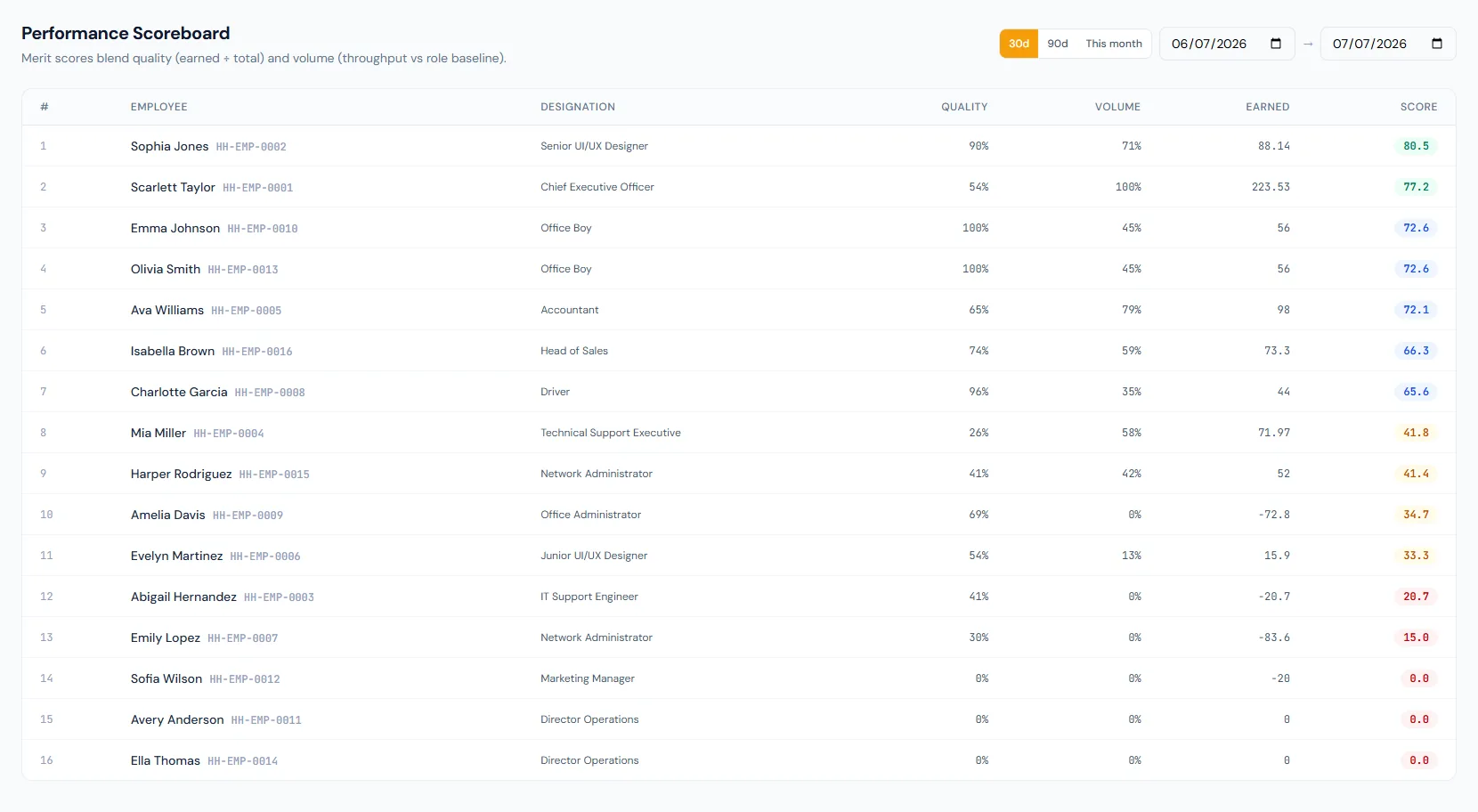
Performance turns daily work into defensible review context: evidence capture, score rollups, formal appraisals, weighted templates, report checks, recurring responsibilities, recognition and increment planning.
The Performance module connects daily reports, tasks, evidence scoring, appraisal cycles, final review outputs and increment recommendations so ratings and pay proposals can be reviewed with context.
Collect daily reports, tasks, attendance, integrations and manual evidence as performance signals.
Record tamper-proof merit evidence and roll it into role-aware quality and volume scores.
Run periodic appraisal cycles with competency templates, self reviews and manager scoring.
Lock final ratings, HR comments, verified appraisal PDFs and review outcomes.
Use merit bands and appraisal outcomes to propose increments while keeping salary changes human-approved.
Run structured review cycles with scores, weighted templates and finalized outcomes.
Open featureDefine time-boxed appraisal periods, due dates, templates and rollout rules.
Open featureUse competency weights and manager responses to calculate defensible ratings.
Open featureConnect finalized appraisal outcomes to salary increment approval records.
Open featureBuild continuous evidence from tasks, reports, attendance and work signals.
Open featureTrace every score back to dated ledger proof, source reference and rationale.
Open featureReview employee daily updates, AI verdicts, missed reports and penalties.
Open featureSet repeating responsibilities and auto-score missed recurring work.
Open featureTurn merit bands into human-approved salary increment proposals.
Open featureRecognize employees through badges, rarity tiers and reward history.
Open featureTasks, daily reports, attendance and optional integrations feed a tamper-proof merit ledger that rolls into a clear 0-100 score for every employee.
Every score is backed by dated source records, earned points, total points, multipliers and rationale so managers can explain review outcomes.
Every AI verdict on a daily report can be overruled by a manager in one click. The correction re-scores the employee through an audit-trailed ledger entry, and the original verdict is kept — so an appraisal conversation always has a defensible paper trail.
The reviewer never penalises effort that leaves no digital trace — client meetings, phone calls, site visits, operations work. It questions a report only when tracked data actively contradicts a specific claim, so non-technical teams are judged as fairly as engineers.
One switch disables AI scoring across the workspace. Reviews then run on transparent deterministic rules, and no report, review or ticket text is sent to any AI provider — a straightforward answer for privacy, legal and works-council reviews.
Finalized appraisal outcomes can create pending increment records, but compensation changes stay inside the normal payroll approval path.
Map your review cycles, scorecards, daily reports, evidence sources, badges and increment approvals to the right HRM setup.
Performance tracking moves reviews beyond memory — managers have task, report and attendance evidence before appraisal season starts.
Weighted appraisal templates keep review cycles consistent, and HR can compare outcomes without losing manager comments or employee self-review context.
Daily reports and missed-report penalties give a clean view of work discipline, and the evidence ledger explains why a score moved.
Increment recommendations stay advisory — finance still approves salary changes, but every proposal carries traceable merit evidence.
When the AI reads a report wrong, the manager corrects it in one click — points re-score on an audit trail, so nobody argues an appraisal against a verdict they cannot challenge.
Sales calls, site visits and operations work leave no digital trace, and the reviewer knows it — reports are never marked down for work the tools cannot see.
Recurring tasks and badges turn performance into an ongoing rhythm — employees see recognition while the formal review process stays intact.
Performance covers appraisals, review cycles, weighted scores, continuous performance tracking, merit evidence, daily reports, recurring tasks, increment recommendations and increment records.
Performance Tracking is continuous evidence-based scoring, while Appraisals are periodic formal review cycles with templates, reviewers and finalization.
No. AI only assists with grading and recommendations — every salary change stays human-approved.
Tasks, recurring tasks, daily reports, attendance, manual evidence and optional GitHub or WHMCS integrations can feed the tamper-proof merit ledger.
Yes. Finalized appraisals can create pending increment records, but payroll approval still controls the salary movement.
They overrule it. Anyone with performance management rights can replace the verdict on a daily report; the employee's points are corrected through a new ledger entry and the original AI verdict is retained for audit. Nothing is silently rewritten.
No. The reviewer is told which employees have connected tools and which do not, and it never treats missing digital evidence as a problem. Meetings, calls, site visits and operations work are judged on the report itself. A report is only questioned when tracked data actively contradicts a specific claim.
Only if you keep AI scoring switched on. One toggle in performance settings disables it across the workspace — scoring then runs on transparent deterministic rules and no report, code-review or ticket text leaves the system.
Your company's. Report deadlines, the missed-report check, activity windows and scoring periods all follow the workspace time zone, so a late-evening submission is never counted against the wrong day.
No. Managers with review rights reach only their own direct reports' tasks; company-wide scoreboards and configuration require HR-level permissions.