
Continuously score performance from tasks, daily reports, attendance, integration signals and manual evidence, then roll the ledger into a defensible 0-100 quality and volume composite.
01Capture signalPerformance Tracking process stepActive
02Book evidencePerformance Tracking process stepActive
03Apply weightsPerformance Tracking process stepActive
Continuously score performance from tasks, daily reports, attendance, integration signals and manual evidence, then roll the ledger into a defensible 0-100 quality and volume composite.
Tasks, reports, attendance, GitHub, WHMCS and manual signals can contribute performance evidence.
Every score is backed by an append-only evidence row with source, points and rationale.
Quality and volume are blended according to company settings to produce a composite score.
Choose a view to see how this module keeps daily HR work structured and reviewable.
Quality is calculated from earned points divided by available points.
Values remain traceable in HRM.The Performance Tracking page helps HR turn tasks, reports, attendance and integration signals into auditable quality and volume scores for review.
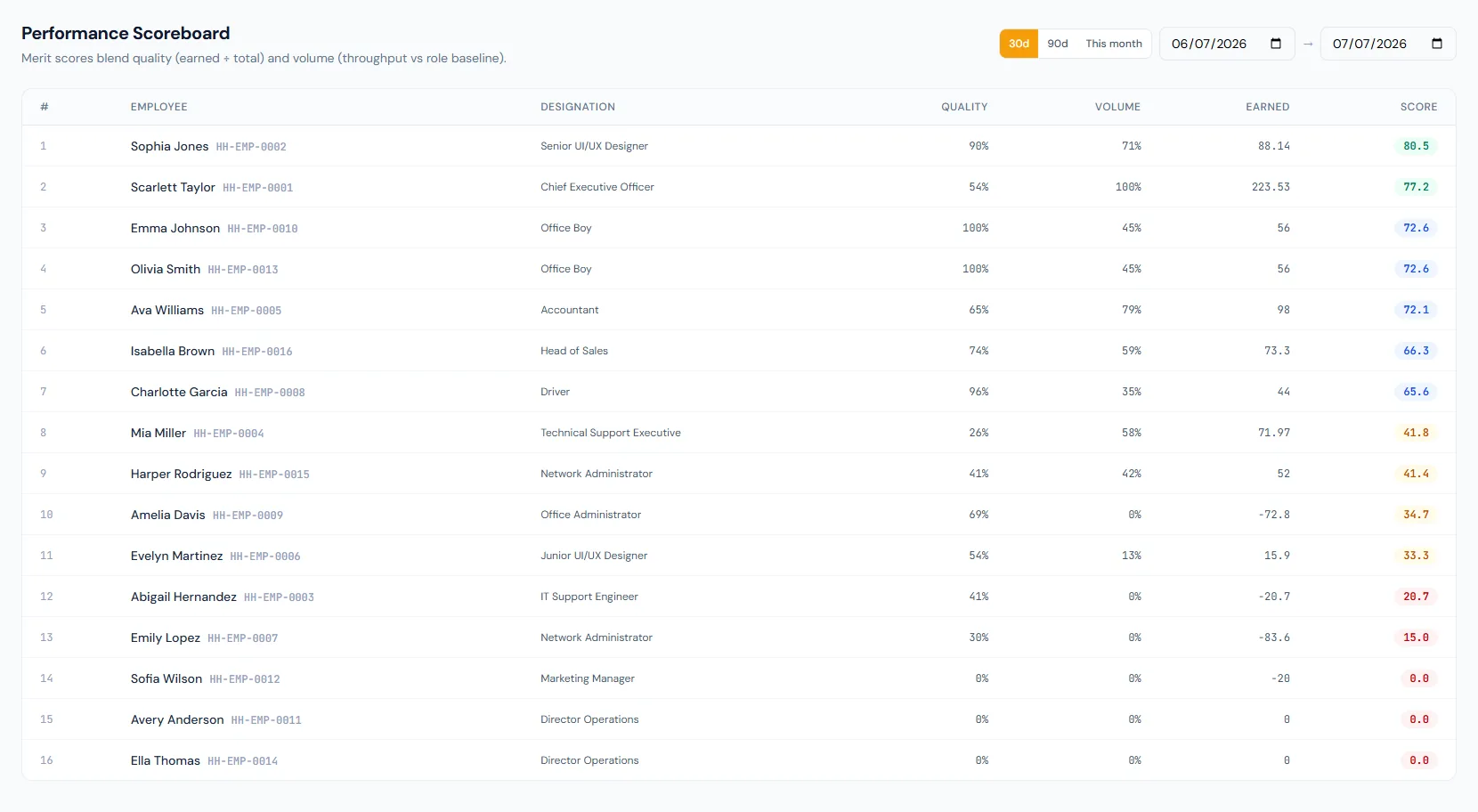
Performance is measured throughout the year, not only at appraisal time.
Quality and volume combine into a defensible 0-100 score.
Different roles can weight evidence sources differently.
Pull request reviews and merges can feed developer merit.
Ticket response speed and quality can feed support merit.
Work both assigned and completed on a non-working day earns a 1.3x multiplier — automatically, and never to amplify penalties.
The structured weekly sales numbers submission is part of this module.
Managers can replace any AI verdict on a daily report; the correction re-scores through an audit-trailed ledger entry.
Meetings, calls, site visits and operations work are never marked down for leaving no digital trace.
One workspace switch turns AI scoring off entirely; scoring continues on deterministic rules with no text sent to any AI provider.
Deadlines, missed-report checks and scoring windows follow the workspace time zone, so distributed teams are judged on their own day.
Department heads reach only their own direct reports; company-wide scores and configuration need HR-level rights.
Increment recommendations route through normal approval flows.
Two measurements are taken over the period, then blended. Quality asks how much of the work booked against someone was actually earned. Volume asks whether there was enough of it for the role. Neither one can cover for the other, which is the point.
62.0of100.0
100 points a month, scaled to the 30 days under reviewcomposite = 100 × (qualityWeight × quality + volumeWeight × volume) ÷ (qualityWeight + volumeWeight)
The per-source weights and the 50/50 blend are yours to set. A shorter review scales the expectation down with it, so ten days of work is never judged against a month of it.
Shared context keeps this workflow aligned with appraisals records.
ConnectedShared context keeps this workflow aligned with performance tracking records.
ConnectedShared context keeps this workflow aligned with merit evidence records.
ConnectedShared context keeps this workflow aligned with payroll records.
ConnectedShared context keeps this workflow aligned with badges & rewards records.
ConnectedNo. Performance Tracking is continuous evidence; Appraisals are periodic formal reviews.
No. Increment recommendations still require human approval.
It is a plan feature — companies on the entry plan see the module switched off until they upgrade.
Yes. A manager replaces the verdict and the employee's points are corrected through a new ledger entry, with the original AI verdict retained for audit.
No. Untracked work is never treated as missing evidence; a report is only questioned when tracked data actively contradicts a specific claim.
Yes. One switch disables AI scoring workspace-wide; scoring continues on deterministic rules and no report or review text leaves the system.
Map your current workflow to the right HRM setup, permissions and rollout plan.